Supercell has pulled back the curtain on a sweeping redesign of the Brawl Stars Championship, and the 2027 season is shaping up to be the most structurally ambitious year in the esport's history. Rather than the familiar single-ladder circuit that fans have followed for years, the new Brawl Stars Championship will run on two connected levels of competition, with a full season divided into two distinct halves. The headline change is the arrival of promotion and relegation, a system that turns every split into a genuine fight for survival rather than a comfortable stroll toward the World Finals.
🏆 A Two-Level Ecosystem
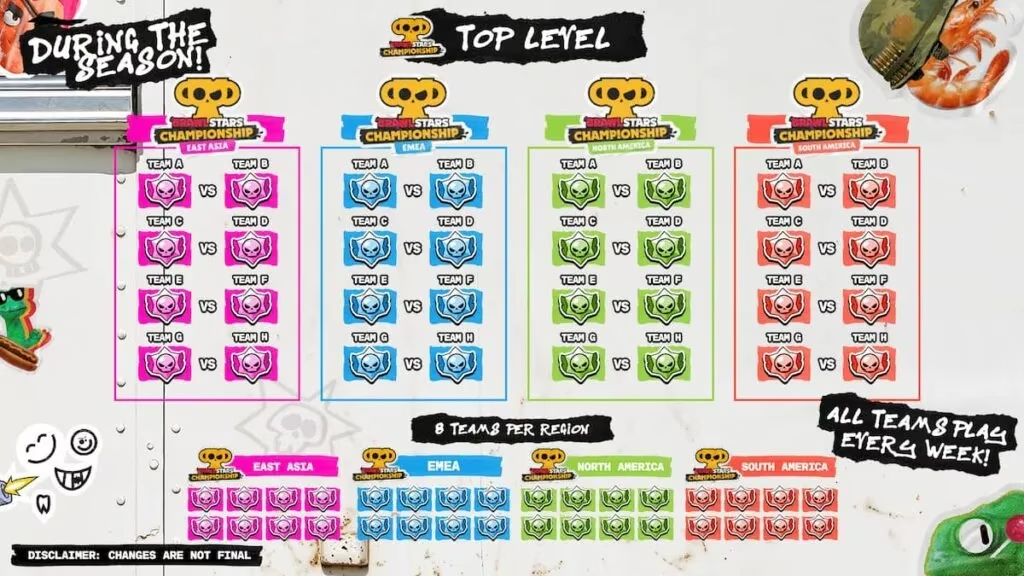
At the summit sits the Top Level, featuring eight teams per region across four competitive territories: East Asia, EMEA, South America and North America. These squads will grind through league matches, playoffs and regional leaderboards across the entire season. The inaugural 2027 lineup will not be decided by open sign-ups alone — it will be shaped by a blend of 2026 performance and a dedicated qualification event.
Beneath that sits Challengers, a far broader pyramid operating across 12 regions. Challengers teams begin in Open Qualifiers before advancing through league play and Playoffs, with the strongest sides eventually reaching the Challengers Finals. Mainland China remains part of the Brawl Stars Championship ecosystem, though Supercell has confirmed that further specifics on its 2027 format will arrive later.
| Level | Regions | Teams per Region | Entry Path |
|---|---|---|---|
| Top Level | 4 (East Asia, EMEA, South America, North America) | 8 | 2026 performance + qualification event |
| Challengers | 12 | Varies | Open Qualifiers → League → Playoffs → Finals |
⚔️ Split 1 and the Road to the Brawl Cup
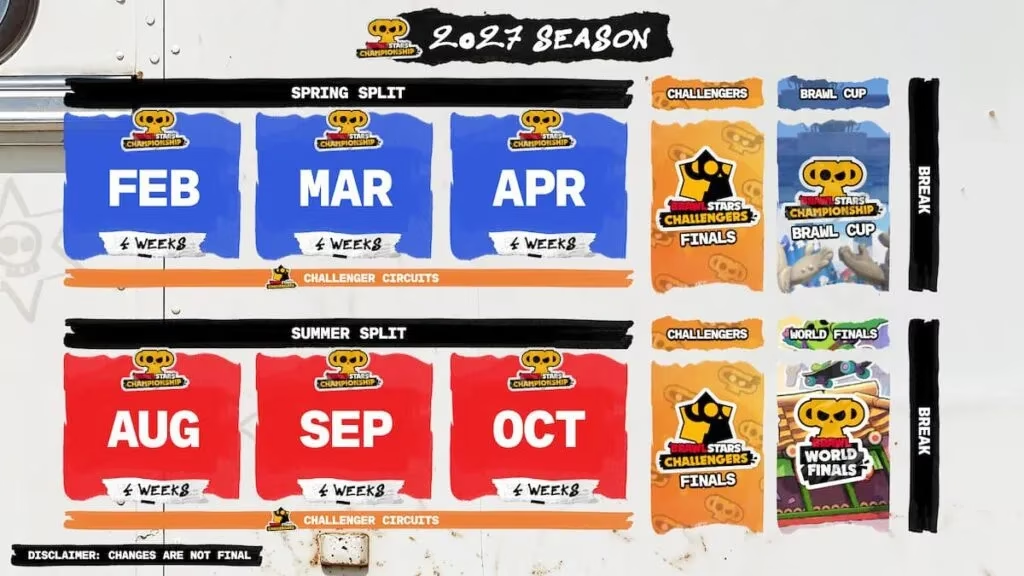
Split 1 spans 12 weeks of Top Level competition. It opens with a group stage in which all eight teams per region collide in a round-robin format, guaranteeing a steady diet of high-stakes matches from the very first week. From there, the schedule moves through the Mid-Season Playoffs, a second Group Stage and finally the Regional Playoffs.
The reward for the teams that survive that gauntlet is a place at the Brawl Cup — a three-day international LAN that gathers the strongest rosters from every region. There is a significant bonus attached as well: the Brawl Cup champion earns an additional World Finals spot for its own region, meaning the stakes extend well beyond the trophy itself.
🔥 Split 2 and the Promotion Battleground
Split 2 mirrors the 12-week rhythm of the opening half but raises the ceiling considerably. Every match now feeds into the Brawl Stars World Finals, the season's ultimate destination and the stage every competitor has circled on the calendar.
For Challengers organisations, meanwhile, Split 2 carries a different kind of weight. The Challengers Finals will determine which teams climb into the Top Level for 2028, while the bottom-placed Top Level squads will be staring down the threat of relegation. It is a format that rewards consistency and punishes complacency — no roster can coast on past glory.
-
🥇 Split 1 → Brawl Cup (international LAN)
-
🌍 Split 2 → Brawl Stars World Finals
-
🔁 Challengers Finals → promotion into the 2028 Top Level
-
⬇️ Underperforming Top Level teams → relegation risk
📅 Why It Matters
Supercell's decision to introduce promotion and relegation is arguably the most consequential element of the entire overhaul. In previous seasons, established teams could rely on their standing and reputation to keep a foothold in the premier competition. Under the 2027 model, that safety net disappears. A bad split can send a veteran organisation down, while an ambitious Challengers squad that performs when it counts can seize a Top Level seat.
The expanded Challengers footprint across 12 regions also signals a clear intent to widen the talent pipeline. More open qualifier routes mean more opportunities for unknown rosters to prove themselves, and the regional depth that follows should make the international LANs more unpredictable.
With the 2026 season already serving as the primary qualifier for the new Top Level, the coming months effectively become an audition period. Teams that treat 2026 as a transition year may find themselves starting 2027 in Challengers instead. For players, coaches and fans alike, the message from Supercell is unmistakable: the Brawl Stars Championship is being rebuilt around merit, momentum and the constant pressure of earning a place at the table.
Comments